03 / Visitor preparation & the dairy bench
A place at the dairy bench
A good workshop begins before the journey. Know what you are joining, tell the host what you need and leave room for a working day to be a working day.
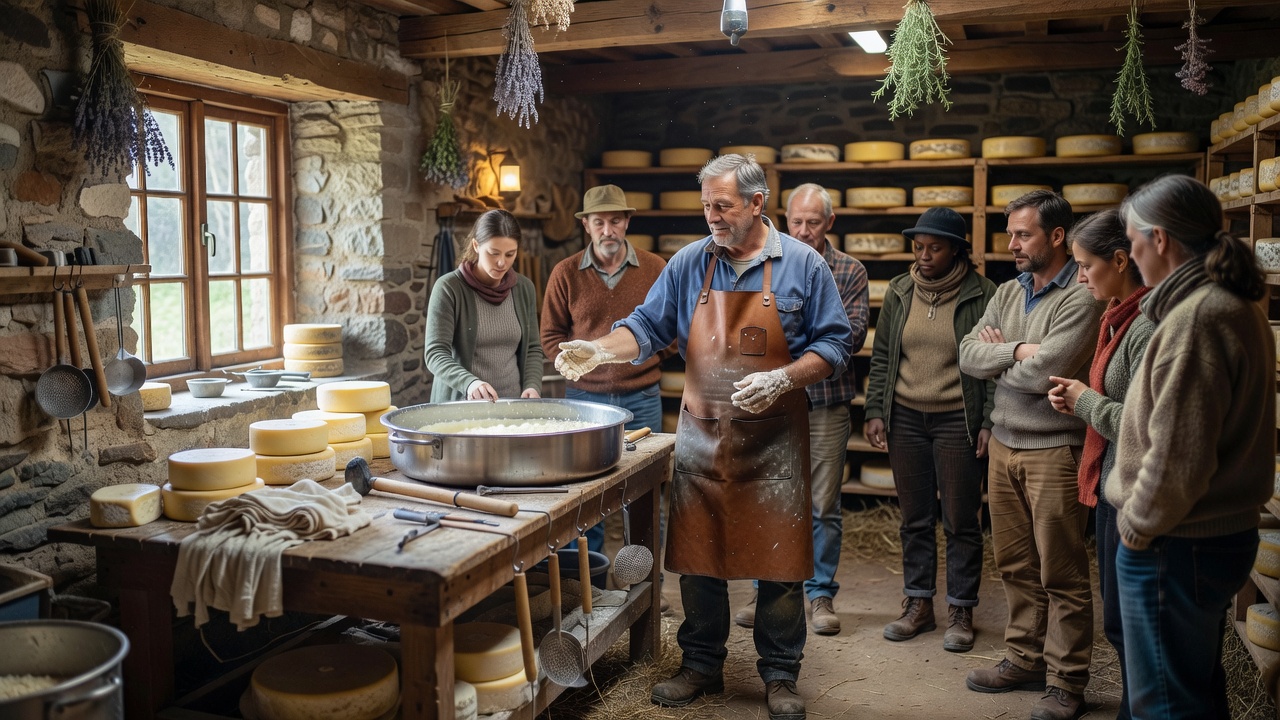
Choose the experience, not just the view
A dairy shop, a demonstration gallery, a guided production visit and a hands-on workshop are different experiences. All can be worthwhile. The important point is to choose knowingly. A viewing window can offer an excellent explanation of commercial production without allowing any contact with the cheese. A small teaching session may give you more practical involvement while showing less of a full-sized dairy.
Read the operator’s own description carefully. Look for an explicit statement of what participants do, who supervises them and whether the activity uses a teaching batch. Do not interpret photographs of a vat as a promise that you will stir it. Our site provides context, not availability, tickets or reservations; only the operator can confirm what is offered on your date.
Ask about the whole route
Accessibility begins at the transport stop or parking place, not at the doorway. Ask about the surface and gradient of the approach, steps, door widths, seating, toilets and how much standing is involved. A historic mountain building and a purpose-built demonstration centre may present very different conditions. Neither “family friendly” nor “accessible” is detailed enough to answer every traveller’s needs.
If you use a mobility aid, have a sensory requirement or need regular breaks, describe the practical requirement rather than relying on a broad label. Ask whether the explanation is audible from a seated position and whether a quieter visit is possible. Production areas can be warm, humid, noisy or strongly scented. A host who knows your needs in advance has a better chance of giving a useful answer.
Fit the visit around production and travel
Cheese-making follows its own schedule. The most visible stage may happen before a leisurely holiday breakfast, and a delayed arrival may miss it. Confirm when to arrive, where to check in and which parts of production the session is expected to show. Opening hours for a shop do not necessarily match the hours when cheese is being made.
Mountain travel adds another layer. Check public-transport connections, walking time and the last realistic return option. Weather can alter roads, lifts and paths even when the dairy itself is operating. Build in time for the approach without arriving inside a restricted work area before the host is ready. Ask how cancellations or weather-related changes are communicated.
Dress for food work, not a photograph
Closed footwear with a secure grip is a sensible starting point, subject to the operator’s instructions. Loose scarves, dangling accessories and unsecured hair can be awkward near equipment. Follow any rules about protective clothing and handwashing. Gloves, where used, do not replace hygiene, and visitors should not bring their own tools into a food-production activity.
Tell the host if you are unwell and ask about postponement rather than joining food handling with symptoms. Keep bags away from work surfaces. Phones should stay out of production unless their use is permitted; touching a phone and then food is not a harmless interruption. Photograph people only with permission, and never step across a boundary to improve the angle.
Make tasting questions specific
Milk allergy, lactose intolerance, vegetarian requirements and pregnancy-related precautions are not the same issue. Explain the relevant need and ask about ingredients, milk treatment, rennet and cross-contact. Ageing does not make a cheese safe for everyone, and an informal tasting table may not be able to provide an allergen-controlled alternative. It is reasonable to enjoy a visit without tasting.
Children may need a minimum age, an accompanying adult or a separate activity. Ask who remains responsible for supervision and whether the session includes hot liquid, sharp tools or heavy equipment. Do not assume a child who enjoys baking will be permitted to handle production tools. A well-designed observation role can be more suitable and just as engaging.
Leave with realistic expectations
If a take-home product is included, ask exactly what it is, when it is ready and how it should be transported and stored. A newly formed wheel that requires maturation is not a finished souvenir. Cross-border food rules can also apply to your journey home. Check the rules of your destination rather than treating a shop purchase as automatic permission to import it.
Finally, thank the people whose working day you have entered. Buy only what you can use and carry responsibly, return borrowed clothing and leave feedback that accurately describes the activity. A thoughtful visit does not need unrestricted access. It needs a clear agreement between a host who must protect the food and a visitor who wants to understand it.
Keep logistics in the right place
These rows identify the authority to consult; they do not assert current opening times or availability.
| Question | Best source | What to confirm |
|---|---|---|
| What will I actually do? | The venue’s current activity page and direct reply | Hands-on access, supervision and inclusions |
| Can I reach and use the space? | The venue plus the local transport operator | Approach, steps, seating, toilets and return journey |
| Is tasting suitable for me? | The host’s allergen information and relevant health guidance | Ingredients, cross-contact and personal precautions |
| What if plans change? | The operator’s booking conditions | Cancellation terms and weather procedure |