01 / Milk & mountain pastures
Milk before the mountain wheel
The first useful workshop question is not “When do we stir?” It is “What milk is arriving here, and what has happened to it already?”
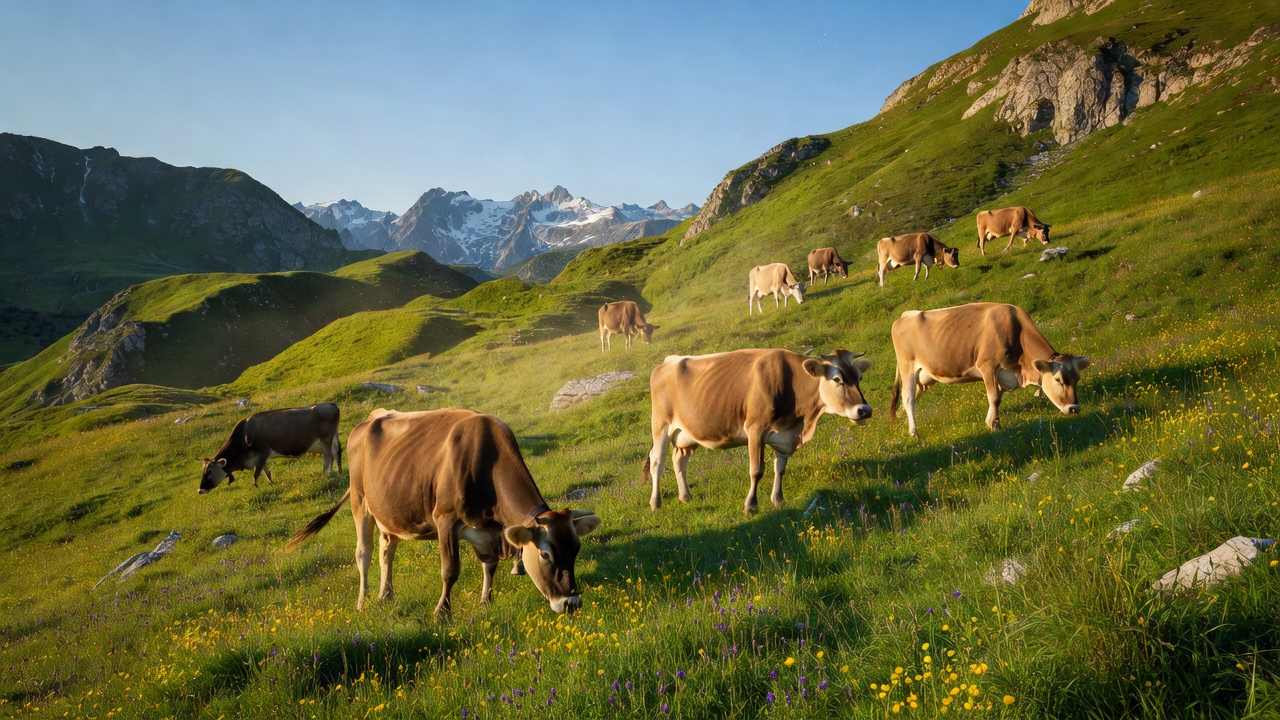
Start outside, without getting in the way
A mountain dairy begins well beyond its walls. Grazing land, water, herd management and the journey from milking to vat all influence the working day. From a public path, notice the terrain and the distance between pasture and buildings. Do not enter fields or approach animals simply because they appear calm. Gates, fences and livestock routes belong to a functioning farm, not to the visitor experience.
Seasonal movement to higher pasture is often described as transhumance or, in German-speaking Alpine regions, through terms connected with Alpwirtschaft. Local practices differ. Some milk becomes cheese near the grazing herd; elsewhere it travels to a village dairy. Neither arrangement can be inferred from a wooden building or a mountain view. Ask where the herd is grazing now and where the milk is processed.
Season is a working condition
Snowmelt, vegetation, weather and animal needs shape the period when a particular pasture can be used. A summer visit to the Bernese Oberland is therefore not a guarantee of finding every mountain dairy in production. A poor-weather day may change access even when cheesemaking continues. Treat published seasonal dates as an invitation to check, not a substitute for direct confirmation.
Feed can affect milk composition and the sensory character of the resulting cheese, but it is only one influence. Breed, stage of lactation, microbial activity and the maker’s decisions also matter. It is more useful to ask a maker what changes through their own season than to announce that all high-pasture milk must taste a certain way. Their answer may concern yield or curd behaviour rather than a romantic flavour description.
Know what “raw” does, and does not, mean
Raw milk has not undergone pasteurisation. That describes treatment, not freedom from pathogens. EFSA identifies food-safety risks associated with drinking raw milk, and vulnerable people need particular care. Raw drinking milk and a matured raw-milk cheese are different products; do not transfer advice between them without checking product-specific public-health guidance.
Pasteurisation is a controlled heat treatment intended to reduce harmful microorganisms. Other heat treatments also exist, so “heated” does not automatically mean “pasteurised.” For visitors, the practical questions are straightforward: what product is being offered, what milk treatment is used, and what advice applies to the person who may eat it? If you are pregnant, immunocompromised or arranging food for a young child, consult current health guidance rather than relying on a tasting host’s reassurance.
Watch the handover into the dairy
Milk reception can look uneventful, yet it carries important work. Clean containers, identification, temperature management and production records help the dairy control its process. Some protected cheeses have precise requirements governing milk origin and handling. The rules for Le Gruyère AOP, for example, should be read through its own official specification, not borrowed from a neighbouring cheese.
You may see milk being filtered, transferred or prepared for the vat. Ask the guide what is happening rather than guessing from a pipe or stainless-steel tank. Do not touch sampling equipment, taps or lids. Visitor hands and clothing should remain outside the production process unless a supervisor explicitly brings you into an approved activity.
Read labels as evidence, not decoration
Swiss AOP and EU PDO are protected-origin schemes with product-specific conditions. “Mountain,” “farmhouse,” “artisan” and “local” do not all carry the same legal meaning in every country. A shop sign can be informative, but the protected name and official documentation provide a firmer starting point. The Swiss AOP-IGP association and the European Commission explain how their respective schemes work.
L’Etivaz AOP offers a particularly useful example of why details matter: its official identity is tied to specific mountain production practices, not simply to being a Swiss hard cheese. Contrast that with a village dairy explaining its daily milk deliveries. Both can teach a visitor something valuable, but they are different stories. Respect the distinction instead of ranking one as automatically more authentic.
Bring three questions to the vat
Ask where today’s milk came from, how the dairy manages seasonal variation, and which rules govern the cheese being made. These questions invite concrete answers without asking anyone to disclose commercial details. If the maker is busy, save them for the guide or the end of the demonstration. The best preparation is enough understanding to recognise the work, and enough patience to let it continue.
Your next observation
Once the milk is ready, watch how the maker changes a liquid into a set that can be cut.
Follow the curd