02 / Curd craft & the Alpine vat
The curd takes shape
A vat can look still while important changes are happening. Learn what each visible movement tells you—and what remains outside a visitor’s view.
A sequence, not a universal recipe
Many Alpine hard and semi-hard cheeses share recognisable stages, but they do not share one formula. Milk treatment, starter cultures, coagulation, curd size, heating, pressing and maturation depend on the intended cheese. A visitor can learn the logic without memorising temperatures or attempting to reproduce a commercial process. Those details belong to validated production methods and the relevant specification.
Before the demonstration begins, ask which cheese is actually being made. A display vat used for a short visitor activity may not follow the same schedule as the dairy’s main production. This is not necessarily a problem; it simply changes what you can conclude from what you see. A clear guide will distinguish explanation, demonstration and saleable production.
First, the milk becomes a set
For many cheeses, selected or traditionally maintained microbial cultures help develop acidity and flavour. Rennet enzymes commonly help milk proteins form a gel. Cultures and rennet do different jobs, even when they are added during the same broad part of the day. Rennet can have different origins, so visitors with vegetarian requirements should ask about the actual product rather than assume.
The moment before cutting deserves attention. Makers assess whether the set has reached the condition they need, using experience alongside process controls. You may see a small test rather than a dramatic change across the whole vat. Avoid treating this as a magic gesture: it is skilled judgement embedded in a monitored process. A useful question is what the maker is looking for, not whether you may try it yourself.
Cutting opens a route for whey
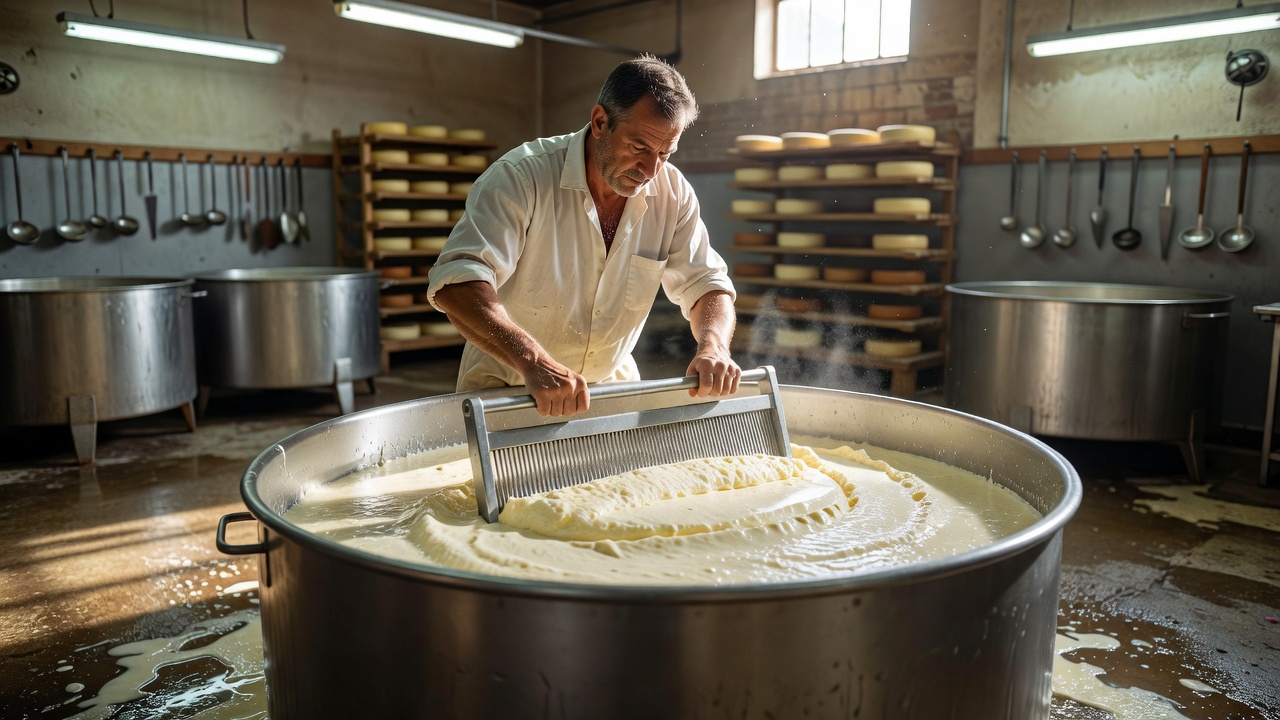
Cutting divides the gel into curds and creates surfaces through which whey can leave. In broad terms, smaller pieces offer more surface area, but the final moisture depends on more than size alone. Acidity, temperature, time and subsequent handling all contribute. Comparing a fine-grained curd for one hard cheese with a larger curd for another style can make that relationship easier to understand.
A harp-shaped tool or wire frame may move through the vat, followed by gentler stirring. Watch whether the maker pauses and how the curd changes from a fragile set into more distinct particles. Do not lean across the vat for a photograph. Hot liquid, moving equipment and the need to protect food make the marked visitor boundary part of the lesson.
Stirring and heating guide the texture
Many Alpine cooked-curd cheeses involve heating while stirring. “Cooked” here describes a cheese-making stage; it is not a blanket statement that the finished cheese is suitable for every person or that the incoming milk was pasteurised. Different protected cheeses specify different conditions. Le Gruyère AOP, Emmentaler AOP and Beaufort are useful examples to compare through their own producer organisations.
Stirring helps keep curds moving and influences how they release moisture. A maker may feel or compress a sample to judge its state. What looks like repetitive work is a series of assessments. Ask how the curd should feel at the next stage and what would change if the milk behaved differently that morning. Respect a short answer when concentration is needed.
From loose curds to a coherent cheese
Curds are gathered or transferred into forms, sometimes using cloth, and many styles are pressed. Whey drains away while the cheese takes shape. Turning and changing pressure may continue beyond the visitor session. A freshly moulded cheese is therefore not the finished wheel that appears in a shop window; it is an intermediate food undergoing controlled change.
Whey also has a destination. Depending on local arrangements, it may be used in other foods, feed or further processing. Ask what this dairy does rather than assuming nothing is discarded or that every by-product becomes ricotta. Responsible production is specific, practical work, not an automatic quality of a picturesque setting.
The cellar is part of the making
Salting may involve brine or other methods, depending on the cheese. Maturation then brings its own routines: turning, rind care and the management of environmental conditions. Microorganisms and enzymes continue changing flavour and texture. The cellar team’s labour matters as much as the highly visible work at the vat, even if visitor access is restricted.
A workshop that finishes at lunchtime can show only a portion of this story. If tasting is offered, ask whether the sample comes from the same type of cheese at a later age, and whether different ages can be compared. The most rewarding souvenir may be a clearer connection between a motion you watched in the morning and a texture you recognise months later.
Leave the recipe to the maker
This guide explains observation, not safe home production. Follow a validated recipe and appropriate food-safety training if you plan to make cheese.
Prepare to join a session